


 Mustaqbal media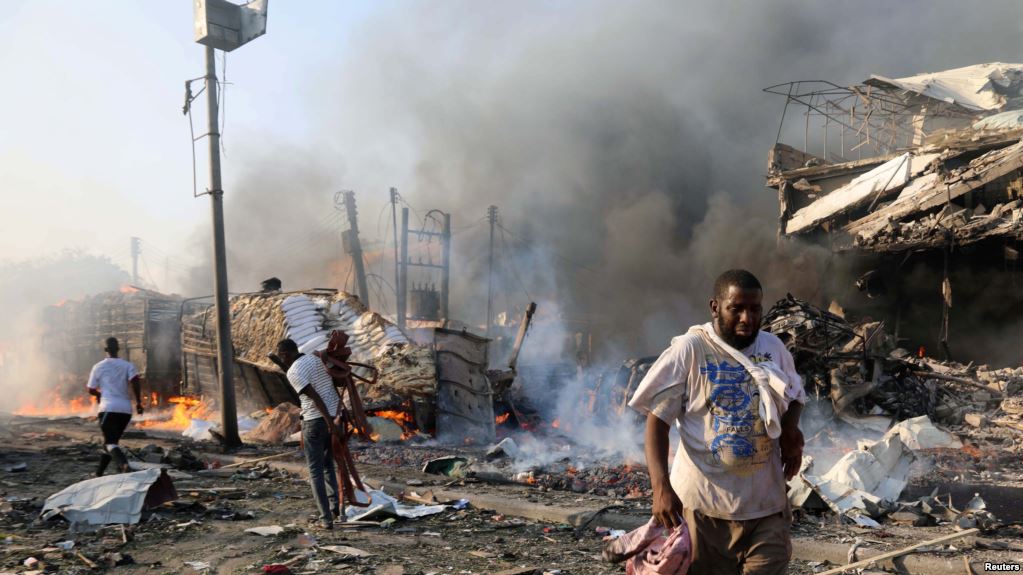
More people have been killed in Somalia. Explosions and direct attacks at government centers, public places such as hotels, beaches, and markets has caused over thousand deaths. The federal government of Somalia with more than 30,000 national army, AMISOM numbering over 22,000 forces, and international partners providing expertise, fund and sophisticated weapons are yet to achieve a breakthrough. At least one-person dies in Somalia every single day. In this week alone, children from Quran School sustained injuries in an explosion targeting Howl Wadaag district headquarter causing the death of four other citizens. Citizens are skeptical of the future of their country.
As I write this article, Leaders of the federal member states are in talks at Kismayo discussing their soring relations with the federal government and the swift political changes in the horn of Africa. All of them are yet to provide administrative efficiency and effectiveness to the people under their rule. None of them can visit some areas under their administration. And above all, they resorted to force majeure, divide and rule policy, and foreign powers linkage to exploit the regions resources for indefinite period.
Scholars and youths remain locked by the insurmountable pressure of the elders, self proclaimed jihadist and the authorized war-lords’ administration in finding creative solution to this suffering. Some have spoken and are unknown in their whereabouts until now. Others were shot dead in broad day light either by the self proclaimed jihadist or by the administration.
To reverse this status quo, many belief that a just leader is the only solution. Others are of the belief that a just society is the ideal. A just society works on the principle of fairness and equity through social cohesion and harmony. To achieve this, scholars lead and youths power is central and the starting point.
A sample illustration of how this works is as follows;
NB: This proposition is of non-political intervention. There will be no change of the district commissioner or whatsoever. A parallel system of scholars and youth established.
Vision: To change Somalia from a country of explosion to a country of exploration.
Mission: create social cohesion and harmony in one single district.
Social divide exist in the country to such an extent that even people living in a single town are divided along tribal lines, classes and religious fanatism (wahabism and sufism). This resulted to mistrust, hatred and immoral acts (corruption and killing) within that locality. Therefore, correction of this leads to a countrywide solution. Our focus now is scholars and youth mobilization.
Step 1
Organize a forum for the scholars and the youths to establish a parallel system of management. The following agendas should be given priority.
- Forgiveness prayer for the town declared
- Conspicuous consumption prohibited
- High marriage cost banned.
- Zakat institution established.
- Waqf(donation) established.
- Training institute for ethical management and research established.
- Funding pool for agriculture and natural resource extraction set up.
Forgiveness prayer for the town declared
Oppression and injustice have occurred in every single town in Somalia. The aim of the forgiveness prayer is to open a new era of accountability, justice and progress. The rich, middle and poor class; the majority and the minority; men and women; farmers and livestock herders; the educated and the ignorant; the teacher and the student; should all respond to the call of forgiveness and ascertain that they will abide to the rule of the Almighty Allah and never engage in any kind of oppression. Scholars and youth elites coordinating the meeting should show commitment and promise that they will give hand to any one oppressed. No grudge is held to anyone who oppressed before as all have now forgiven. Oppression is past and gone. This builds confidence of the society, makes them think positively and creatively.
Trainings
People’s connection to Allah, the Almighty is the most important training religious scholars should give. This yields social morality and concern for others. A society all whom are accountable to their Lord and are fully aware of this vicegerent (Khalifah) are more likely to promote and uplift morality. “And is there any reward for good other than good” (Q55:60). This type of training should encompass all the classes and levels of the society- from the administrators to the poor.
Another second important training is the formal education. In every town, there are some people who are expert in at least one field- there can be found economist, medical doctors, administrative experts, techno-friendly, sociologists and religious experts. Division of labour and specialization is applicable at this stage. Everyone should make sure that efforts are not spared in their endeavor to the towns’ mission.
Two outcomes are very important in the trainings. High standard of living with high standard of moral. High standard of moral is achieved through religious training while high standards of living is achieved through building strong economic base. Both religious and formal education are indispensable. Increasing the literacy rate yields higher living standard.
A local based training and research institute to exploit creative and innovative means to increase agricultural productivity and extraction of other natural resources should be set up. Scholars should develop a training manual on good governance so that efficient and effective leaders graduate from the institute. Trainings on good governance is inclusive.
Conspicuous consumption discouraged
Society should be trained in such a way that their mindset is focused on more production and less consumption. Consumption of luxurious items by the wealthy should be discouraged and if need arises should be banned. This is to save more wealth for investment and job creation. It also helps build social cohesion and prevent socio-political instability. “You cannot be in a third world country and live as the first world countries”- FMR PM of Singapore. Simple lifestyles that conform to the norms and values of the society is to be maintained. Even if you are rich, the surplus wealth should be used for productivity and not consumption. Trainings provided should have shaped and instilled them in simple lifestyle.
High marriage cost banned
High marriage cost encourages materialistic lifestyle and that is why more and more youth cross the Mediterranean Sea in such of materialism. This is nothing but a corrosion of morality and unawareness of the purpose of life. Meaningful life where people compete in creativity, efficiency and social harmony should be encouraged. NGO workers, Diaspora and Affluent people’s consumption and expenditure should be closely monitored and ensured that their expenditures do not erode social harmony. If left alone, they create anomie with their careless expenditure. The high cost paid in marriages could be invested in productive business thereby creating job opportunities. Also, youths when married act more responsible and morally upright than when lonely (bachelor/sphinster). Marriages also creates social stability. To set an example, children of the scholars and town administrators should initiate this process.
Zakat
Zakat is a social security system ordained in the Qur’an by Allah (swt). It is a right of eight categories of people mentioned in the Qur’an. The poor, the debtor and the Zakat collectors are among the eight categories. This system creates social harmony through;
- Provision of job opportunity (Zakat collectors)
- Lifting burden (the debtor)
- Alleviate poverty (the poor)
Besides these benefits and more, the poor who are paid Zakat might invest that capital and earn high return. Perhaps, this capital increases and reaches a maximum amount (nisab) required to pay Zakat and then he/she pays the Zakat. The Zakat system could have eradicated poverty in the world if applied efficiently and effectively. A major tool to fight poverty ordered by the Creator and ignored by the creatures, man in particular. Another important aspect the Zakat system plays is the social solidarity. When poor people in the society are confident that their right on the rich is guaranteed, they behave morally and fulfil their duty towards the society. No grudge held between the different classes.
Waqf (donations)
Waqf an institution of voluntary charity serves a great deal in the economic wellbeing of the society. It was through Waqf that great services like hospitals and education centers were established.
Poor people have had access to services like health care, education, and the likes through Waqf, thereby improving their living standards. Some Waqf services impart knowledge and skills to develop entrepreneurial talents among the poor. This has helped lower the effects of poverty. Since Waqf is a long lasting charity, it suits in eradicating poverty in poor countries.
Financing Waqf projects is done by the rich for the benefit of the poor. This has positive implication on the redistribution of wealth in the society thus lessening the effects of income inequality in the society.
Invigorating Agricultural investment and productivity
Agriculture remains one of the most important economic development tool. Agri-business is the starting point of development. Lack of skills, capital and brainwashed mentality hinders its development. Trainings could help find solution to skills need and wrong mentality. For capital provision, a lot of alternative funding are available.
Funding scheme for agricultural productivity.
No Riba is allowed in the provision of finance. Contractual agreements such as partnership and benevolent loan (interest free loan) serve some of the modes of financing. Focus should be given to more production so that they are transported to other towns for purchase and aid.
How about the whole country?
This simple strategy focusing building social cohesion and harmony in one district could be spread to other towns in the country. Once other towns apply, then whole country is corrected. As a result a just society governed by a just leader is more likely to emerge.
Why I choose this strategy?
- Once a man came to Omar bn Khatab and asked him, “Why are we in difficulty (suffering) in your time and not when Abu bakar was a Khalifah? Omar replied, “During Abu bakar’s reign, I (omar) and good people like me were under his leadership but my time (now), bad people like you (the man) are under my leadership”. This emphasizes the need for upright society for effective and efficient administration.
- “A strong economic base is more vital to a nation in the long run than military superiority; and nations which stretch themselves beyond what their economies will sustain are looking for a fall”. Paul Kennedy
Written by: ABDIHAKIM SHARIF ABDIKADIR
.IBNUSHARIF2@GMAIL.COM