

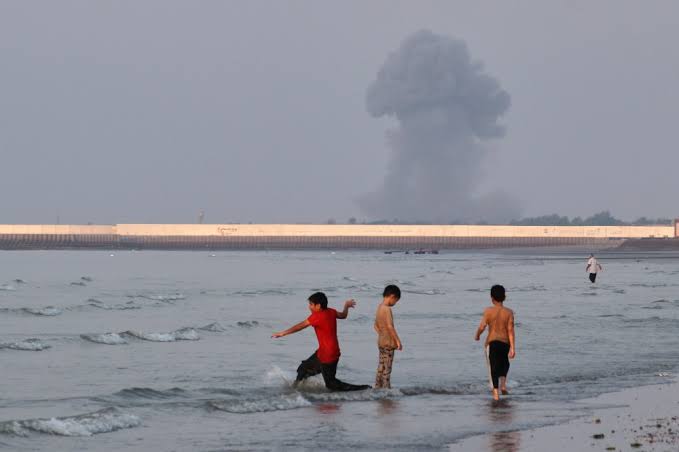
The United States launched another wave of military strikes against Iran early Tuesday, prompting Tehran to retaliate with attacks on Bahrain and two UAE-linked oil tankers in the Strait of Hormuz, further escalating tensions in the Gulf.
The renewed confrontation came hours after US President Donald Trump announced Washington was reinstating its blockade on Iran in the Strait of Hormuz, while also signalling that the United States would seek to charge commercial vessels for security and safe passage through the strategic waterway.
According to the US Central Command (CENTCOM), American forces launched a new round of strikes targeting Iranian military capabilities to weaken Tehran’s ability to threaten international shipping in the Strait of Hormuz. “These strikes will continue imposing a heavy cost on Iranian forces and degrade their ability to attack innocent civilians and commercial shipping in the Strait of Hormuz,” CENTCOM said in a statement.
Speaking at the White House shortly after the strikes, President Trump said the United States was carrying out another major military operation against Iran. “We’re hitting them very hard. It’ll continue, and we’ll see what happens,” Trump told reporters. “We’re knocking out all of their offensive capability and we’re controlling the straits. We’re putting the blockade back.”
The US president also said Washington intended to recover the costs of securing maritime traffic by charging commercial vessels using the Strait of Hormuz. “We’re protecting a very rich portion of the world. We’re spending money, and we are going to be reimbursed for that protection,” he said.
The proposal marks a significant departure from longstanding US policy supporting unrestricted freedom of navigation through international waterways.
Iran responded by launching attacks across the Gulf, including missile strikes targeting Bahrain and attacks on two oil tankers associated with the United Arab Emirates. According to the UAE Ministry of Defense, two cruise missiles struck the tankers Mombasa and Al Bahiyah while they were transiting the Strait of Hormuz.
The attacks set both vessels on fire before the blazes were brought under control. The UAE said one Indian crew member was killed, while eight others were injured, including six Indian nationals and two Ukrainians. Iran’s Islamic Revolutionary Guard Corps (IRGC) claimed responsibility for the attacks, saying the vessels had ignored repeated warnings and entered what it described as a restricted area.
The UAE condemned the attacks and warned that it reserved the right to respond. “The UAE reserves its full right to respond to this escalation and take all necessary measures to protect its territory, citizens and residents,” the Defense Ministry said. Military aircraft were reported flying over Dubai following the attacks.
Bahrain also came under fresh missile attack early Tuesday, prompting authorities to activate air raid sirens for the third time in recent days and urge residents to seek shelter.
Iran claimed responsibility for multiple rounds of missile attacks targeting the Gulf kingdom. No immediate reports of casualties or damage were released by Bahraini authorities. Jordan also confirmed that its air defense systems intercepted several missiles that crossed its airspace on Tuesday morning.
The latest exchange of attacks has further intensified the struggle over the Strait of Hormuz, one of the world’s most strategically important maritime chokepoints through which nearly one-fifth of global crude oil and liquefied natural gas supplies pass during peacetime. Concerns over the escalating conflict pushed global oil prices sharply higher, with Brent crude rising 7.8% to $81.92 per barrel during early trading.
Although prices remain below the peaks recorded during the height of the conflict earlier this year, analysts warn prolonged instability could drive energy costs significantly higher worldwide.
Source: THE DIPLOMATIC INSIGHT
